
HHL AI & BUSINESS INSTITUTE
AI for competitive advantage
Rent the model. Build your own harness.
The AI race has just begun. Every company can rent the same models. Lasting advantage comes from what you build around them. Many people call many things a harness. We use the word for one thing: the system that puts your knowledge, your systems, your rules and your judgment to work in the products that define you. We build it with you, inside your company.
Your products and processeswhat your customers pay for
YOUR HARNESSbuilt by you, improves with every run
Knowledgeprocesses, cases, exceptions
SystemsERP, CRM, mail, documents
Ruleslegal, brand, permissions
Judgmenttests, acceptance, human sign-off
ClaudeGPTGeminiopen-weight
RENTED MODELS: interchangeable, the same for every competitor
88% of companies use AI. 6% earn with it. The race for results has just begun.
The common view is that a few model providers have won and everyone else can only buy from them. For the models that is largely true, and it does not matter: the best closed models change hands between a handful of labs, and open-weight models follow them within three to six months. Whatever a competitor rents today, you can rent tomorrow.
What has not been decided is who turns those models into profit. Almost nine in ten companies use AI somewhere, but only four in ten see any effect on operating profit, and about one in sixteen earns a meaningful share of profit from it. Most companies are still in the first wave: AI as a helper at the desk. The advantage compounds fastest in the third wave, and almost nobody is there yet.
Source: McKinsey & Company, The State of AI, November 2025 (1,993 respondents). Open-weight models trail the best closed models by about three to six months (Epoch AI, 2026).

Rent the model. Build the harness. The model is table stakes. The harness is the moat.
Prof. Dr. Florian Ellsaesser
Chairholder | Thalia Chair of Marketing and Retail | Head of HHL AI & Business Institute
Same model, almost four times the result: the harness decides what AI delivers.
The word harness is used for many things in the market. Here is what we mean, and we mean exactly this:
A harness is everything a company builds around a rented AI model so that the model works the way the company works: what it knows about you, which of your systems it may use, what it must never do, and where a person signs off.No horse pulls without a harness, and no model works for you without one. A bought harness runs someone else’s process. Your own harness runs yours, on every case, at machine speed.
A language model predicts words. It has never seen your contracts, your customers, your exceptions or your standards. Everything that makes its output correct for your business comes from outside the model: the knowledge you feed it, the systems you connect, the rules you enforce and the checks you run before anyone acts on the result. That outside part is the harness, and it is why the frontier labs now ship their own harnesses with their models (Anthropic’s Claude Code, OpenAI’s Codex).
Only the harness passes the test for a lasting advantage. Strategy research asks whether a resource is valuable, rare and hard to imitate. The rented model is valuable, but every competitor rents the same one and the vendor replaces it every few months. Your harness is built from your cases and your exceptions, which nobody else has. When the core technology is available to everyone, the profit goes to whoever owns the specialised assets around it. In AI, that asset is the harness.
Source: Zheng et al. (2026), Claw-SWE-Bench, arXiv 2606.12344 v2, Table 1 and Section 6.1: GLM 5.1 with a bare and a full OpenClaw adapter, 350 issues from 43 repositories, averaged over three runs.
Test for lasting advantage
| Criterion | Rented model | Your harness |
|---|---|---|
| Valuable | ✓ yes, for everyone | ✓ your process, on every case |
| Rare | ✗ every competitor rents it | ✓ built from your data and exceptions |
| Hard to imitate | ✗ replaced by the vendor every few months | ✓ a rival would need your history of cases |
Barney (1991), firm resources and sustained competitive advantage · Teece (1986), profiting from technological innovation
Build it for the two or three products that define you, with your customers in the loop.
Most AI use cases are generic. Buy them. The few that shape what your customers pay you for you build yourself, as part of the product. And you keep changing the product as the harness learns: harness and product evolve together, or there is no advantage.
What this means for a CEO. Decide which two or three products carry your competitive position. Run product and harness on one roadmap, with one pioneering team of two to three people on each: one who owns the product and signs off, one who builds the harness, one who sits with the customers. In our projects a first version is in use within weeks, and every exception the team finds becomes part of the harness. That is the method we build with you.
How much it shapes what customers pay for →
Buy and integratestandard customer service
Build your harnessthe AI inside your core product, your advice, your know-how at the customer
Buyoffice copilots, translation
Buy and configureinternal search, HR, finance
How specific the knowledge is to your company →
Harness and product evolve together
Product in usewith real customers
Product changednew features, offers, workflows
every loop widens the gap
Usage and exceptionsproprietary, fresh, yours
Harness learnsrules, skills, tests added
Hagiu & Wright, When Data Creates Competitive Advantage, Harvard Business Review, 2020
The strongest parts of a harness are learned from your data, not written.
A rented language model reads, writes and reasons. It does not know how your demand moves, which claim is risky or which past case resembles this one. Those are predictions, and predictions are learned from data. So a good harness surrounds the rented model with models trained on your records: forecasting and risk models the agent can call, retrieval tuned to your documents, small models fine-tuned on your recurring tasks, learned routers and checkers, and a loop that turns every signed-off case into training data.
- Specialised beats general. 224 of 310 small models fine-tuned on one task each beat GPT-4 on that task, by 10 points on average (Zhao et al., 2024).
- Learned routing pays. A router trained on preference data halved model cost at 95% of GPT-4 quality (Ong et al., ICLR 2025).
- Learning from your own records works. Reinforcement learning on a history of software changes lifted an open model to the best result of its size on SWE-bench Verified (Wei et al., NeurIPS 2025).
For a CEO: put your data scientists and your harness team in one room. Every forecasting or risk model you already own becomes a tool the agent can call, and every case your experts sign off makes the harness better.
Agrawal, Gans & Goldfarb (2018), Prediction Machines · Zhao et al. (2024), LoRA Land · Ong et al. (2025), RouteLLM · Wei et al. (2025), SWE-RL
YOUR HARNESSrented in the middle, learned around it
Predictdemand, risk, price, churn
Retrieveyour documents and cases
Rented language modelreads, writes, reasons, calls the learned parts
Specialisesmall models fine-tuned on your tasks
Route, checklearned routers and checkers
▲updates the harness
Learnreinforcement learning on outcomes
▲signed-off cases, results
Your own harness keeps you independent of any provider and in control of your costs.
Because the harness, not the model, holds your knowledge and your rules, the model becomes a part you can replace.
closed, US
closed, EU
open-weight
own servers
plug in, test, switch
Independent of any provider
A well-built harness is model-agnostic. Change the model, keep the harness: your knowledge, rules and tests carry over. You can run closed models, open-weight models or your own models on your own hardware, and move when price, quality or policy change.
Risk covered: a provider raising prices, changing terms or being blocked by regulation.
STAYS WITH YOUprocess knowledgecustomer and case datarules, tests, sign-offwhat the AI has learned
task only→
model
you decide which model may see what
Sovereign over knowledge and data
Your know-how is written down in your harness, not inside a vendor’s product. You decide which model may see which data, where it runs and under which jurisdiction. Your AI keeps working whatever a provider does.
Risk covered: GDPR and EU AI Act obligations are enforced in the harness, not left to the vendor.
HARNESSroutes each task
↗ routine stepssmall modelcents per task
↘ hard judgmentsfrontier modelonly where it pays
your tests decide what is good enough
In control of your costs
The harness decides which model handles which task and your tests show which is good enough. Small models are listed at a fraction of frontier prices per token, typically 80 to 95% less. Spend becomes visible per task and per product and can be capped like any other cost.
Risk covered: an AI bill that grows with usage and nobody can explain.
Three waves of AI. In each, the advantage is your own knowledge in a new form.
Where your knowledge lives
AUGMENTEDhelp for a taskyour knowledge inpeople’s skills
AUTOMATEDfixed path, engineeredyour knowledge indefined processeslight harness
AUTONOMOUSgoal clear, path openyour knowledge injudged, validated agentsthe full harness + a pioneering team of 2–3compounds fastest here
how much of the work the AI carries
▶
Augmented: your people get help with a concrete task. Your knowledge lives in their skills: who uses AI well, for what, and with what judgment. That is yours and hard to copy, and the barrier is culture: half of the employees who use AI are reluctant to admit it. Leadership has to say out loud that use is wanted and rewarded.
Automated: a recurring task with a fixed path is engineered into a flow, with a light harness around it. Your knowledge now lives in the process definition, which is custom to you. In one of our projects a bank halved its backlog of 8,000 open regulatory requests this way.
Autonomous: the goal is clear but the path differs every case. Your knowledge lives in agents your experts have judged and validated: the full harness, with your tests and sign-offs, run by a dedicated pioneering team. Here it compounds fastest, and most companies have not started.
Our framing of the three phases in Microsoft & LinkedIn, Work Trend Index 2024 and 2025 (31,000 workers, 31 countries): companies in the later phases report thriving at twice the global rate (71% vs 37%).
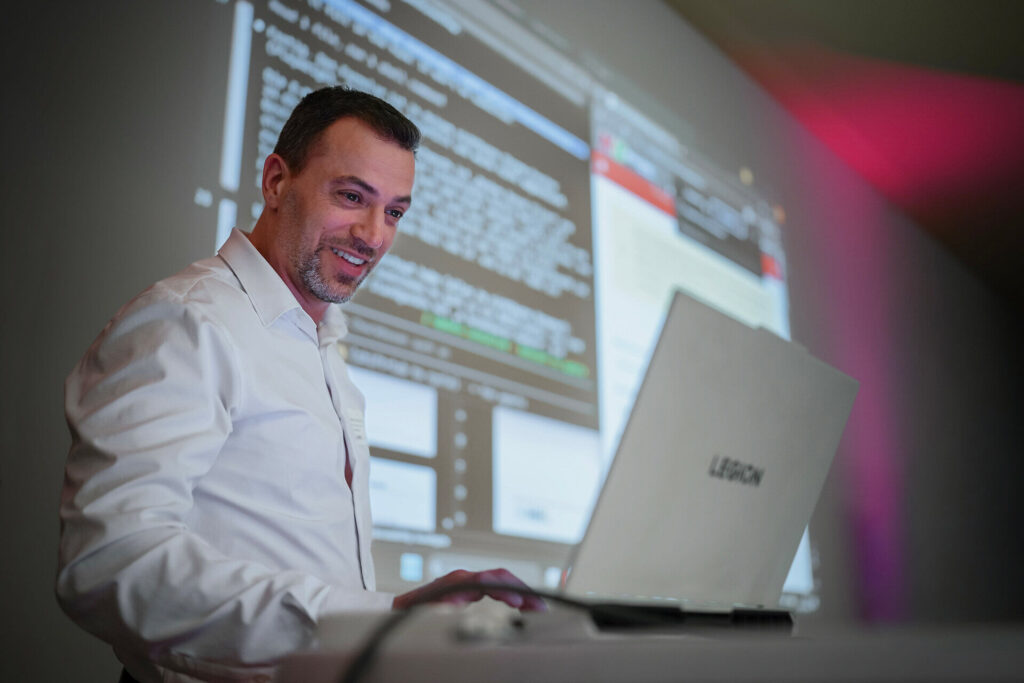
We build it with you: our faculty, your pioneering team of two to three and MBA | AI students, inside your company.
Member companies bring a real product or process. We form a pioneering team with your people, build the harness together and put it into use. Your team runs the loop on its own afterwards, and what we learn flows back into research and teaching.
Learning by implementing. Our students and executives do not analyse cases about AI. They implement AI in your company, supervised by faculty who have built these systems themselves. Students work under NDA and never see more of your data than the task requires.
Learning by implementing
Researchhow AI creates value
insight→
TeachingMBA | AI, executives
frameworks→
Implementationin member companies
▲
new questions, data and exceptions from practice
every project feeds the next course and the next paper


What we offer
- Company membership
A circle of member companies that build their own harnesses with us and see research results first. - Managerial AI Readiness Survey
An annual benchmark of how ready management is to turn AI into results, measured outside-in for more than 1,000 companies. - Executive AI Forum
Confidential peer exchange for executive and supervisory board members on what has worked in AI and what has not. - Teaching and executive education
The Full-time MBA | AI with 40 ECTS of AI, AI modules across HHL programmes, and executive programmes that start from your own harness.
Members bring one product, get a trained team and a working harness that belongs to them.
We work with a small circle of member companies. Membership terms are agreed individually in a first conversation.
You bring
One product or process that carries your competitive position. A pioneering team of two to three of your people with time to build. A sponsor on the executive board who signs off.
You get
A first harness in production, built with our faculty and MBA | AI students. Your team trained to run the loop without us. The harness and its know-how belong to you. First access to the Managerial AI Readiness Survey and a seat at the Executive AI Forum.
How it starts
A first conversation, then one page on your product or process. We form the pioneering team with you and begin.
Research results first, and an invitation to our events.
A few emails a year: new findings, Executive AI Forum dates and Institute events in Leipzig.
A founding team with 30 years of building AI systems and research in the leading management journals.
Hands-on AI engineering, consulting experience from McKinsey & Company, and publications in the Journal of Marketing, Strategic Management Journal and Academy of Management Review.

Prof. Dr. Florian Ellsaesser
Founder and Director | Chairholder, Thalia Chair of Marketing and Retail
Specialised in: Harness engineering, reinforcement learning, natural language processing
- Ten years of AI research and engineering, from reinforcement learning and language models to production harnesses
- Research on AI in management decisions, published in the Strategic Management Journal and Academy of Management Review
- PhD in Strategic Management, University of Cambridge
- Founder and advisor of AI start-ups
- Formerly McKinsey & Company, Berlin

Dr. Levente Szabados
Senior Research Fellow and Head of AI Engineering | Habilitation candidate
Specialised in: Deep learning, knowledge representation, multi-agent systems, open-weight models
- Twenty years of applied AI, from knowledge representation to deep learning, natural language processing and agent systems
- Lecturer at Frankfurt School of Finance & Management since 2018: Deep Learning, NLP, Frontiers of AI
- Industry: led quantitative research teams; CTO and senior AI consultant for start-ups and corporates
- Research on agentic AI, harness engineering and how people and AI systems work together
Start the conversation
One page on your product or process is enough. We reply within a week.