
Why a Part-time MBA Later in Your Career Is a Smart Next Step
At some point in your career, the question changes. “What’s next?” becomes “Is this still the right direction? Am I still on the right path?”
For many experienced professionals, that’s exactly the moment when the idea of a Part-time MBA comes up and is often followed by hesitation.
Have you wonderd whether going back to business school later in your career is a step backwards or a smart move forward? If the answers is yes, this perspective is for you.
Experience Changes the Question
Early-career MBAs are often about exploring options. Trying things out. Figuring out what kind of leader you want to become. Later in your career, the situation looks different. A part-time MBA for experienced professionals is less about credentials and more about perspective, leadership, and leverage.
You are not lacking skills. You have built those over years. You have led teams, you have delivered results, you have dealt with complexity. What is often missing is not competence, it is leverage.
Leverage in the sense of stepping back, challenging your own patterns, and gaining a broader perspective. At this stage, education is not about adding more knowledge, it is about reframing what you already know.
Why Waiting Feels Responsible — and Often is not
Many professionals delay the decision for good reasons:
- I want more clarity first.
- I need to be sure it is worth the investment.
- The timing should be better.
On the surface, that sounds reasonable. And often it is. But at some point, waiting stops being strategic and becomes a habit. Careers rarely come to a sudden halt. They slow down gradually. Not because ambition disappears, but because routines settle in and things start to feel “good enough.”
Experience should help you make clearer decisions, not just safer ones.
More articles about studying a Part-Time MBA



From Competence to Impact
One thing stands out when we look at our participants with more experience: their intention is different. They are not studying to prove themselves. They are studying to sharpen how they think and decide.
They use the MBA as a framework to:
- rethink their leadership approach
- pressure-test career decisions
- expand their influence beyond their current role
- translate experience into broader impact
What becomes clear here: it is not about starting over. It is about building on the knowledge and skills already gained and doing it more deliberately.
Why a Part-time MBA Makes Sense Precisely Now
At a later stage in your career, motivation usually is not the issue, alignment is. This is why a part-time MBA later in your career often feels more relevant than it would have earlier on.
A Part-time MBA offers exactly that:
- structured reflection instead of constant second-guessing
- exposure to peers who challenge your thinking
- a clear framework to turn experience into strategic leverage
The real value is more than the degree itself. It is the quality of the decisions you make afterwards and the confidence to actually follow through.
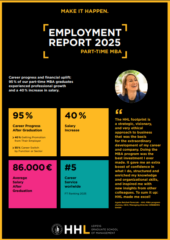
Check out the latest employment stats of HHL’s Part-Time MBA graduates in our latest employment report. Download it for free!
A Different Kind of Career Move
Choosing a Part-time MBA later in your career is not catching up. It is choosing direction.
Not earlier. Not later. Just more intentionally.
And in many ways, that is the most senior decision you can make.

Hello, I'm Stephanie. After spending several years in the hospitality industry in both the US and Germany, I joined HHL as a program consultant for the part-time MBA in October 2022. As a service mind at heart, I am happy to answer your questions. How can HHL help you to achieve your career goals through our Part-Time MBA program? I look forward to hearing from you—let's explore how we take your career to the next level!