From MBA to ESG Impact: How Pingkan Applies Her HHL MBA Learnings in Practice
How do MBA learnings translate into real impact after graduation? For one HHL alumna, the answer lies in ESG, sustainability and creating meaningful change within one of Indonesia’s leading financial institutions. From circular economy initiatives to financial literacy programs, her work today reflects many of the ideas, frameworks, and values she first explored during her MBA journey at HHL.
In this blog post, Pingkan shares how she applies her MBA learnings in practice and how they continue to shape her work, leadership, and approach to sustainability today. Her story shows how MBA and ESG can come together in practice when business knowledge, responsible leadership, and sustainability goals are applied in real organizational contexts. For students considering an ESG career after an MBA, her experience offers a concrete example of how sustainability, strategy, and leadership intersect.
Bringing MBA Learnings into ESG Work Today
I’m currently working as an Assistant Manager in the ESG Division at PT Pegadaian (HQ in Jakarta), Indonesia.
Since ESG is still quite new in our company, my role is very dynamic. I help introduce and integrate ESG into the organization. I’m part of the Communication & Monitoring Department, so my work revolves around communicating ESG values, running campaigns, and supporting ESG ratings. On the monitoring side, I’m involved in preparing key reports such as the Sustainability Report, Sustainable Financing Framework, Social Financing Implementation Report and even Social Return on Investment (SROI). This makes ESG reporting a central part of my work, connecting sustainability goals with measurable business and social impact.
In addition, I’m also the PIC (Person in Charge) for Financial Literacy. In this role, I design programs and coordinate various initiatives across priority segments defined by OJK (Otoritas Jasa Keuangan-Indonesia’s Financial Services Authority). Through these programs, I contribute to promoting financial inclusion and empowering communities with better financial knowledge. It involves organizing events, collaborating with different stakeholders, and engaging with diverse groups, which also allows me to meet and connect with many inspiring people.
In short, I communicate with almost everyone, because ESG is not just about a division, but about how we work and live as individuals within the company. At the same time, I also manage my team and spend quite a bit of time behind the desk working on reports.
One of the biggest challenges is stakeholder management. ESG requires strong coordination across many internal divisions, employees at all levels, regulators, and external partners. Aligning everyone toward a shared understanding and goal is both challenging and exciting.
Applying the Leipzig Leadership Model to ESG Work
One framework that really stays with me from HHL is the Leipzig Leadership Model (LLM). I still actively apply it in my work today. For me, this is where responsible leadership becomes practical: using frameworks from the MBA to guide everyday ESG decisions.
One framework that really stays with me is the Leipzig Leadership Model (LLM), which I actively apply in my work:
If I think about a concrete example, I’d highlight the courses Business Ethics and Business Environment, Society, and Leadership. I especially apply the Ethical Compass by Prof. Dr. Andreas Suchanek, with its four principles: Freedom, Embeddedness, Respect, and Self-Restraint.
These principles are very relevant to ESG. My role requires me to ensure that ESG becomes part of the company culture, from headquarters to branches and units. The idea of “Do No Harm” is something I carry with me: how can we create impact, support SDGs, and help more people without causing unintended harm?
There are definitely moments when I think, “This is exactly what I learned during my MBA.” Sustainability and ESG were strong themes at HHL, and now I’m directly working in that field, it feels very aligned. We aim for profit, yes, but we also care deeply about people and the planet (the 3Ps).
From Circular Economy Lessons to Real ESG Programs
Additionally, I also really enjoyed the Sustainable Innovation module at HHL, which consisted of the courses Circular Economy and Sustainability, Society, Social Entrepreneurship & You. These courses helped me understand how businesses can create impact while still being sustainable, not only for profit but also for society and the environment. I can really see the connection now in my ESG work, especially when we develop programs that aim to create long-term value. The circular economy perspective helps me think beyond short-term initiatives and consider how ESG programs can create lasting environmental, social, and business value.
Looking Back at the HHL MBA Experience
Honestly, every moment at HHL was meaningful for me. But if I had to highlight one, it would be the course Responsible Entrepreneurship for the Common Good by Prof. Timo Meynhardt.
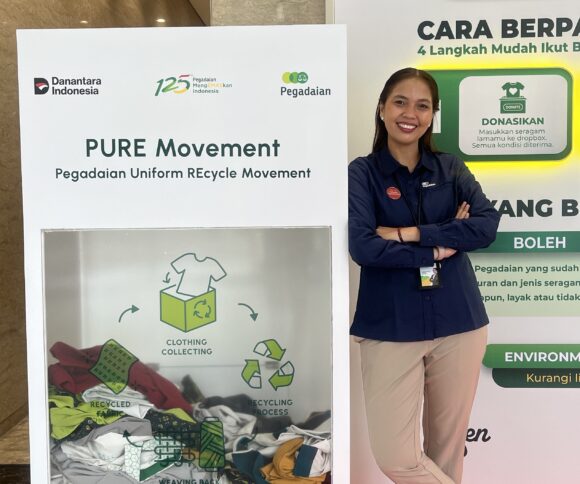
We worked with a real client, Wildplastic, and that experience stayed with me. Recently, on 22 April 2026, we launched the PURE (Pegadaian Uniform Recycle Movement), a program that recycles used uniforms into new clothing. We collaborated with PABLE in Indonesia, and it really reminded me of my experience with Wildplastic.
I was part of the project initiation, and it has been very successful so far. Employees were excited to donate their uniforms, and the feedback has been very positive, even regional offices want to replicate the program. So there is strong potential to scale it further.
HHL also gave me a very supportive environment, through peers, faculty, and the network. That spirit continues in my workplace.
ESG Impact and Personal Development After the MBA
The MBA has really shaped how I approach problems and make decisions. Courses like Managerial Decision Making, Mindful Leadership, Business Ethics & Leadership, Leading High Performance Teams, and Change Management & Stability have helped me become more structured and intentional.
Now, I don’t just focus on planning and executing, but also on monitoring and evaluating. At the same time, I’ve learned to stay adaptable and sensitive to local context.
I also joined the New Leipzig Talents Program (2023–2024), which helped me continue developing through coaching and mentoring, even now with my managers at work.
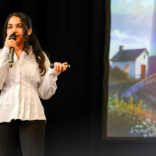
In terms of impact, I’ve become more actively involved in sustainability: attending conferences, speaking at events, and applying ESG in my personal life. For example, I’m more mindful about what I consume, I’ve started wearing circular fashion, and I try to be a real example of an ESG-driven employee.
Most importantly, I feel that I can influence others too, and that’s very meaningful for me.

Want to discover more about our top tier and innovative MBA programs? Dive deeper into the program structure, learn more about career development and networking at HHL.
Additionally, during my time in Leipzig, I learned German Sign Language (Deutsche Gebärdensprache – DGS) at the Spracheninstitut of Universität Leipzig (it was recommended by Ellen), where I completed Level 2. I have continued learning it here in Indonesia.
This experience has become very meaningful in my current role, as my work allows me to engage with people with disabilities. It has deepened my awareness of inclusion and strengthened my commitment to ensuring that our ESG programs create impact for a wider and more diverse society.
HHL also gave me a very supportive environment, through peers, faculty, and the network. That spirit continues in my workplace. I’m actively involved beyond my core role, whether as an MC, a speaker at events, or supporting our Christian employee community (Oikumene). And I feel supported in return.
What makes the HHL MBA particularly strong is its “learning by doing” approach. It’s not just about theory, it’s about applying, reflecting, and connecting knowledge to real-world challenges.
Advice for Future MBA Students
If I could give one piece of advice to future MBA students: be present and mindful during your journey at HHL.
You will learn a lot, through theory, case studies, and group work, but the real challenge (and beauty) lies in how you implement it in real life. Stay open, build meaningful connections, and be willing to adapt your knowledge to different contexts.

Hello there, I'm Ellen and international education and student mobility is my thing! I did my first language course in the UK at the age of 14 and I have been an exchange student in Denmark at university. I have lived in Malta and Ireland for 15 years to work with international students and support them on their individual and exciting journeys to improve their education. I joined the HHL community in 2021 as a program consultant for the full-time MBA program and I am very much looking forward to accompanying you on your next steps of this life-changing journey. Any questions about the full-time MBA program? Let's have a chat!